Showing posts with label Hidden Classics. Show all posts

Saturday, October 19, 2013

Hidden Classic #6: The Devil's Storybook


This charming little book is full of witty stories about the Devil, who is portrayed as a short-tempered trickster always trying to stir up trouble. Sometimes the Devil gets the results he wants, other times the people he's trying to deceive fool him instead. All the tales have a subtle moral, mostly about the consequence of choices or desires, and a lesson about human nature.And several are really, really funny.

Natalie Babbitt was born and grew up in Ohio. She spent large amounts of time in those early years reading fairy tales and myths, and drawing. Her mother, an amateur landscape and portrait painter, provided early art lessons and saw to it that there was always enough paper, paint, pencils, and encouragement. In those days, Ms. Babbitt wanted only to be an illustrator. She spent a lot of time drawing at Laurel School in Cleveland and went on to major in studio art at Smith College.

As befits Babbitt's early training as an artist, a suitably wicked but hilarious drawing accompanies each tale.

But don't just take my word for it! Check out these credentials.....

"A masterful Devil's advocate, Natalie Babbitt presents ten brief testimonials to Satan's unflagging gusto for dirty tricks. Paunchy and well past his prime, this Prince of Darkness is no Superdemon."--Starred review, School Library Journal

"High on my list is The Devil's Storybook by Natalie Babbitt. This Devil is not dire; he is a scheming practical joker and comes to earth often when he is restless, to play tricks on clergymen, goodwives, poets, and pretty girls."--Jean Stafford, The New Yorker

"[Babbitt's] Devil is a cultured fellow who drinks cider, reads novels and gives concerts for the damned. He also has a sense of humor, frequently employed at human expense. What he lacks, however, is real malevolence. Parents who are concerned about their children's reading matter will be relieved to see that this book has virtually no violence, making it a tame match for the average cartoon - or, for that matter, Grimm's fairy tales." Laurel Graeber, The New York Times

There's also a very nice review at The Excelsior File.

Recommendations:
Association for Childhood Education International
Booklist, starred review
Bulletin of the Center for Children's Books
Children's Book Review Service
Elementary School Library Collections, selected choice
Horn Book Magazine, starred review
Kirkus Reviews, starred review
New York Times Book Review
Publishers Weekly
School Library Journal
, starred review
Wilson Library Bulletin

Awards:
American Library Association Notable Children's Books
Children's Book Council Children's Choices
Horn Book Magazine Fanfare List
National Book Awards Finalist
New York Times Notable Children's Books of the Year
School Library Journal Best Books of the Year
School Library Journal, Best of the Best Books for Children

Thursday, January 26, 2012

Hidden Classic #5: Trouble In Bugland


Ask anyone to name a famous private detective, and their first response will undoubtedly be "Sherlock Holmes." More tributes, sequels, spinoffs, and parodies have been written based on the works of Sir Arthur Conan Doyle than on any other mystery and detective writer. Personally, I'm a big fan, and I look forward to any twist that a current author cares to put on the stories I have loved since I was about ten years old.

Which brings us to Trouble in Bugland: A Collection of Inspector Mantis Mysteries by William Kotzwinkle. Kotzwinkle keeps the basics: the Victorian setting; the fast-paced action; the master detective with a brilliant mind and finely-tuned deductive reasoning; and the ever-faithful and valuable sidekick. There is, however, one major change from the original: all of the characters are...insects.

This creative choice adds many twists to the tales that Doyle fans know so well. The brilliant detective is a praying mantis with super-sensitive antennae and an iron grip. His partner is a grasshopper who is an accomplished long-jumper (and it is he, not his mentor, who is the accomplished violinist). A bookworm absorbs top-secret naval plans when he mistakenly ingests a coded message. Butterflies are kidnapped, their wings are stripped for their "jewels," and their bodies are tapped for the poisons they excrete in self-defense.

The best part of this book is that the stories are delightful both for readers new to Holmesiana (or to detective stories in general) and for fans of Holmes who will appreciate the full range of the cleverness and humor that Kotzwinkle brings to these stories. He never talks down to his readers, yet the stories remain accessible to a wide audience. And I can't wrap up this review without mentioning the spectacular color plates and pen-and-ink drawings throughout. "Profusely illustrated by Joe Servello," promises the cover, and it does not lie. Nearly every page features beautifully detailed examples of insects, all amusingly rigged out in Victorian costume.

This book is tragically out of print, as happens with many wonderful children's books, but it is available at a few libraries, and used copies are readily available for purchase online, most for under $10. If you or anyone you know loves good detective stories, Sherlock Holmes stories in particular, or even stories about bugs, don't miss this one!

Monday, February 7, 2011

Hidden Classic #6: The Little House


The Little House was my very favorite picture book as a child, and it remains so today (I still have my childhood copy, ragged though it is). It's the sweet and perfectly-illustrated story of a little house with a soul who, after years of neglect, is returned to a home in the country with a family to love and care for her. The little pink house has the most charming, life-like face, and as a child I always wanted to live in it. In some ways, I still do.

It was only as an adult, sharing the book with children, that I realized that this is a classic example of a carefully, meaningfully politicized picture book. The little house, sturdily built during a simpler age, loves her life in the country but harbors a strong curiosity of what it might be like to live in the city. Her curiosity is satisfied when the city encroaches on her countryside home.

Since this is a picture book, in many ways it oversimplifies the tension between the country and the city, and the country is set up as a universal good while the city is painted as a heartless villain. Yet at the same time it provides a clear context--as relevant today as it was in 1943--through which to question the "progress" of development and rampant urbanization. However, Burton denied it was a critique of urban sprawl, but instead wished to convey the passage of time to younger readers, which she does beautifully.

The Little House was awarded the Caldecott Medal in 1943 (given annually by the American Library Association to the artist of the single most distinguished American picture book for children), and was selected as one of the "100 Best Books of the 20th Century" by the National Education Association. It received rave reviews from its first appearance in 1942 onward and has never gone out of print since.

If The Little House and her other picture books were her only legacy, it would be more than enough. But Virginia Lee Burton's talents extended beyond creating wonderful picture books. "[T]o speak only of Burton's achievements as a picture book creator would be to paint only a part of the canvas of her life. She was also a dancer, an illustrator for an early Boston newspaper, a musician, a designer, a sculptor, and a printmaker." (from "Virginia Lee Burton: A Centenary Tribute" at www.carlemuseum.org)

Other books by Virginia Lee Burton:
Calico the Wonder Horse
Choo Choo
The Emperor's New Clothes
(illustrations)
Katy and the Big Snow
Life Story
Maybelle the Cable Car
Mike Mulligan and His Steam Shovel
The Song of Robin Hood


"If the page is well drawn and finely designed, the child reader will acquire a sense of good design which will lead to an appreciation of beauty and the development of good taste. Primitive man thought in pictures, not in words, and this visual conception is far more fundamental than its sophisticated translation into verbal modes of thought." ~ Virginia Lee Burton, "Making Picture Books", The Horn Book Magazine

Thursday, December 23, 2010

Hidden Classic #4: The House Without a Christmas Tree


In honor of the holiday season, I went back and looked at my list of favorite children's holiday books, and this was right at the top: The House Without a Christmas Tree by Gail Rock, one in a short series of novels about the incomparable 10-year-old Addie Mills. Unfortunately, the series is out of print, but several libraries in the system still have copies, and this particular title was filmed as a must-see made-for-TV movie in the 1970s that is still available on DVD.

I was curious as to what other people thought about the book, which is truly a hidden classic that not many have read. I found this delightful review on Goodreads from a friend of a friend named Tatiana, and it says it all:

"I was looking for a Christmas novel that 1) had heart, 2) wasn't sappy, and 3) didn't make me cry. I found it in The House Without a Christmas Tree: sweet, concise (I read it today), and old-fashioned in the best way. It's the story of Addie Mills, a fiesty 10-year-old in 1946, who can't understand why her father won't allow them to have a Christmas tree. Father and daughter both have trouble communicating with those they care about, and so it's good they have Grandma to bridge the gap. Grandma tries to make Addie see the situation from her father's point of view, that of a man who's still grieving the loss of his wife, while simultaneously explaining to her son the importance of loving the ones still with us. But it takes a series of miscues, including Addie dragging a tree through town (twice!) before all can be resolved. A lovely story that leaves you hoping there really are girls like Addie Mills in the world and wishing you could know one."

The only thing I'd change about this review is that it does, in fact, make me cry. But not because it's deliberately "tear-jerking" or emotionally manipulative in any way. Rather, because it's a lovely story told simply and honestly, and out of that simplicity and honesty comes the true emotion of the piece. Not to be missed.

There is also a very nice, but brief, fan site for Addie. Check it out!

Praise for the Addie Mills series:

As befits a true "Hidden Classic," there aren't many professional reviews still around for this series, or for this book in particular. But everywhere you go on the web, all of the reader-based reviews (via sites like Amazon, Goodreads, LibraryThing, ALibris, etc.) consistently give Addie at least 4 out of 5 stars.

Screenwriter Eleanor Perry won a prime time Emmy for "Outstanding Writing Achievement in Drama - Adaptation," and director Paul Bogart was nominated for a Director's Guild Award, both for the made-for-TV movie of The House Without a Christmas Tree.

And there is a lovely Time article praising the adaptation: "The Little Christmas Classic That Could."

Tuesday, October 26, 2010

Hidden Classic #3: Bedtime for Frances


I am old enough to remember vinyl records, and I once owned many. Among my favorites were a collection of 45 RPM recordings that came with matching paperback books, so you could either read along or listen to them at bedtime, just like the book & CD kits of today. The ones that my brothers and I listened to and read over and over again, our favorites, were the Frances stories, written by Russell Hoban and illustrated first by the incomparable Garth Williams and then by Hoban's first wife, Lillian.

Frances is a temperamental badger child, whose escapades are in part based on the experiences of the four Hoban children, Phoebe, Brom, Esmé, Julia, and their friends. Her stories are Bread and Jam for Frances, A Baby Sister for Frances, A Birthday for Frances, Best Friends for Frances, Egg Thoughts and Other Frances Songs, and the original (my favorite), Bedtime for Frances. The events of the story will be familiar to children and to their parents: first, she wants a glass of milk, then a piggyback ride, then her teddy bear and doll, then extra kisses. Even after all of that, sleep eludes her, so she makes up a little song to sing to herself (her songs are the best parts of the books). But there is a tiger in her song, which makes her wonder if there is a tiger in her bedroom....or maybe a giant....or maybe spiders will come out of the crack in the ceiling....or maybe a ghost is moving the curtains.....

Throughout it all, Frances is charming and ingenious and unique, yet completely believable. And her parents' initial patience and humor, followed eventually (and inevitably) by firmness then exasperation, will be all too familiar to anyone who has ever tried to get a young child to sleep. Hoban's words and Williams' drawings complement each other perfectly.

It wasn't until years later that I realized that Hoban was a local boy, born and raised in Lansdale, PA. Or that he also wrote novels for older children and adults, including the award-winning The Mouse and His Child. Or that he was also an illustrator himself. Williams, a writer-illustrator in his own right, has provided the artwork for many childhood classics, including The Rescuers series by Margery Sharpe, The Little House series by Laura Ingalls Wilder, Charlotte's Web and Stuart Little (both by E.B. White), several stories by Margaret Wise Brown, numerous Golden Books, and all children's titles by George Selden (including A Cricket in Times Square). Interesting, but not necessary at all to the enjoyment of Frances and her very relatable adventures. They have never been out of print, and I hope they never will be. They are truly classics in every sense of the word.

Bedtime for Frances
written by Russell Hoban
illustrated by Garth Williams
published by HarperCollins, 1960
31 pages with illustrations
Recommended read-aloud ages: 3-8
Recommended read-alone ages: 6-8

Praise for Frances:

"An enchanting picture book with winsome illustrations and a text in which there is humor and a real sympathy for the maneuvering of the reluctantly retiring young. " ~ Bulletin of the Center for Children's Books
"Here is the coziest, most beguiling bedtime story in many a day." ~ Kirkus Reviews
"Williams' drawings have become inseparable from how we think of those stories. In that respect... his work belongs in the same class as Sir John Tenniel’s drawings for Alice in Wonderland, or Ernest Shepard’s illustrations for Winnie the Pooh." ~ Gordon Campbell in the introduction to Williams' The Rabbit's Wedding
"Anyone who has ever put a little one to bed will find this delightfully familiar, and the children themselves will enjoy the gentle humor and coziness of the story." ~ School Library Journal

Friday, September 17, 2010

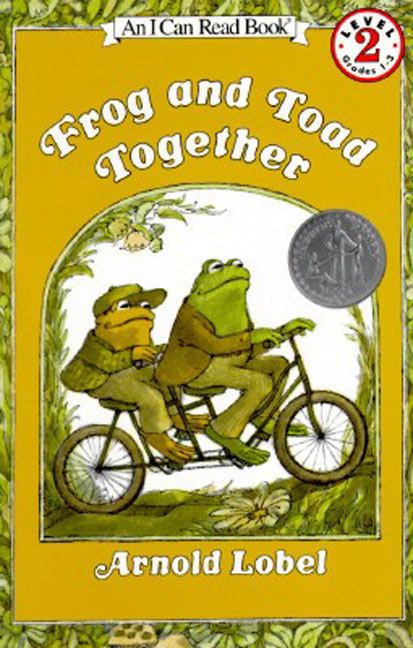
Hidden Classic #2: Frog & Toad Together

“‘I cannot remember any of the things that were on my list of things to do. I will just have to sit here and do nothing,’ said Toad.” It is this kind of silly, subtle humor that combines with the sweetness of true friendship to make the Newbery Honor book Frog and Toad Together so appealing.

The second volume in author-illustrator Arnold Lobel’s classic Frog and Toad series, this book consists of five episodes that explore the adventures and practical education of Frog and Toad, who learn lessons about patience or restraint in everyday situations, like waiting for seeds to grow or knowing you should stop eating cookies but not being able to.

(And we've all been there, right? No? Just me?)

Originally published in 1972, the art may seem a little simple and dated to modern children, but Lobel’s simple line drawings filled in with watercolor browns, greens and grays perfectly complement his stories. 20-point typeface and plenty of white space make the story visually approachable for new readers, while the narrative introduces increasingly complex vocabulary words and themes, including what it means to be brave and the importance of sharing the spotlight.

Appropriate for preschoolers and younger elementary school children, even adults will enjoy these tales.

Check it out on Library Thing

Hidden Classic #1: Freddy the Detective

Welcome to "Hidden Classics," a review series that will focus on children's books from the 20th century that you might have forgotten about or missed reading entirely. Each entry in the series will tell you a bit about the book/series and its author, and will recommend both a read-aloud age level and a read-alone age level. If you have any suggestions for "Hidden Classics," feel free to add them to the Comments section below. Happy reading!

Today's entry is the funny, humane, and altogether delightful Freddy the Detective by Walter R. Brooks. It's actually part of a series of Freddy's adventures, written between 1928 and 1958. Brooks was a staff writer for The New Yorker, and contributed stories to The Saturday Evening Post, Atlantic Monthly, and Esquire. His short story "Ed Takes the Pledge" was the basis for the 1950s TV show Mr. Ed. The Freddy series went out of print in the 1960s but was brought back into print in the 1990s due to overwhelming requests from Freddy fans. Freddy even has a newsletter, an annual convention, a book of poetry, and several fan sites. The best is the one run by the Friends of Freddy: http://www.freddythepig.org/ (check out the gallery of Freddy's disguises).

Freddy is the "smallest and cleverest" of the animals on Bean Farm, a fictional place set near Syracuse in upstate New York. The animals at Bean Farm are famous for their ability to talk and read, but, unlike most children's books, the author acknowledges that talking animals are unusual, and a lot of the humor comes from this. Freddy is somewhat of a Renaissance pig: in the novels, he becomes a cowboy, an explorer, a politician, a publisher, a poet, a magician, a banker, a campaign manager, a pilot, and (my favorite) a detective.

In Freddy the Detective, our hero goes crazy for Sherlock Holmes and decides to start his own detective business. Beginning with the disappearance of a toy train which the rats steal to ride safely back and forth from their holes to the feedbox, he solves a series of very mysterious cases in which all of the animals become involved. What I love about Freddy is that he always has good intentions but, like all of us, he sometimes stumbles: "But Freddy really had no ideas at all. There was no good using force; he had tried that, and all he had got out of it was a broken tooth that sent his family into fits of laughter whenever he smiled. Anyway, detectives seldom used force; they used guile. He went back to his library and got comfortable and tried to think up some guile to use on the rats. And as usual when he lay perfectly still and concentrated for a short time, he fell asleep." Yes, he is a bit lazy, messy, and sometimes fearful, but he's a loyal friend and a first-rate detective. Go, Freddy!

Freddy the Detective
by Walter R. Brooks
published by Overlook Press, 1998
264 pages (but with illustrations and very large print)
Recommended read-aloud ages: 5+
Recommended read-alone ages: 8+

Praise for Freddy:
"Pure fun from beginning to end." ~ The Horn Book
"There's a richness to the world of Bean Farm and a strong moral code that is timeless." ~ The Los Angeles Times
"They are the American version of the great English classics, such as the Pooh books or The Wind in the Willows." ~ The New York Times Book Review
"Freddy the Pig is back. Hooray!" ~ The Philadelphia Daily News
"Freddy is simply one of the greatest characters in children's literature!" ~ School Library Journal